
Award-winning Learning Management Software & Compliant Safety Courses
ENGAGING ONLINE COURSES ON ANY DEVICE
You don’t need a computer lab to deliver engaging & compliant online safety training courses. SafetyNow by CoAction works on any device in even the remotest locations. Your workers will like the powerful storytelling and activities that reinforce the learning. You will like the transparency, metrics, and efficiency. What’s more, SafetyNow by CoAction is the only solution with RETENTION, timed online reinforcers that improve retention 8x.
IMPLEMENT IN MINUTES, NOT WEEKS
What keeps your team from getting the most out of a learning solution? SafetyNow by CoAction is so easy to use, there’s almost no learning curve. Even better, you can track engagement and progress in real-time, so you can focus on the employees that need your support.
CERTIFIED & COMPLIANT TRAINING PLANS
Don’t know where to start? Use a SafetyNow by CoAction Training Path to quickly launch an annual, quarterly or customized training program. Start with a professionally made template or work with one of our certified safety experts to develop your own.
Already Registered?
Forgot how to get to your eLearning?Go to the LMS
Already a Member of eLearning? Go to YOURCOMPANY.bridgeapp.com to login.
SafetyNow Bridge sends out many different types of notifications via email. Some examples include:
- When the user is first created
- When a new course is assigned
- After a course becomes overdue
- Weekly summaries of courses they must take
- etc.
As an admin, you can view every single notification that has been sent to a user, when it was sent, and see a preview of the email itself.
To view a user’s notifications, start by going to the Admin section via the Application Switcher. From there, click on Users & Permissions and in the menu that appears, click Manage Users.
You’ll see a list of all the users in your account. Click on the user’s name who you want to view notifications for, then click on View Notifications.
That will show you all the notifications ever sent to the user. You can see the email itself by clicking on the eye icon.
Important! Only users with email addresses will receive notifications.
SafetyNow sends out notifications for quite a number of events. You can take total control over this, however, and choose exactly what emails get sent out.
Note that not all users have the ability to edit notifications.
To get started, go to the Application Switcher and click Admin. From there, click Account Management, then Notifications.
This will bring you to a screen showing you all of the notifications that SafetyNow sends out, along with a brief description. Let’s check out the overall settings first though.
Send Email Notifications [1] will allow you to turn on or off all emails that SafetyNow sends out. Clicking on More Settings [2] will allow you to change where the emails come from and who your learners will reply to:
The From Label can be anything, like a name, company name, etc. The Reply Address has to be a valid email address – anyone who replies to an automated SafetyNow email will send their reply to that address.
And that’s it! There are tons of settings on this page, so explore and let us know if you’re not sure what an email is.
Before you assign a course, it’s often wise to preview the course content itself. The way to do this is to assign the course to yourself. This is the same as assigning the course to an individual, but let’s go through the process from beginning to end.
First, go to the Author tab and search for the course you wish to preview. Once you find it, click the name of the course to be brought to the main course page. From there, click Learners.
The Learners page will list all of the Learners already assigned to the course. To assign it to yourself, click +New Learner and then type in your own name into the new box. Finally, click on the account that comes up to assign the course to yourself.
You’ve now assigned the course to yourself. From here, click on the Application Switcher and go to My Learning. From there, you should see the course on your dashboard. If not, just search for it, and click the course. That will drop you straight into the course, and you can preview it before you assign it to people!
In SafetyNow, you can place users together within individual groups. Users are added to a group manually. Once you create a group, you can add the group to a course or program. Any users already in the group will be assigned that course or program, and any users added later will also receive it. In this way, you can create a whole curriculum that works automatically.
If you want to create a dynamically created group defined by group rules, then you’ll want to create a Smart Group.
First, we’ll need to head to the Admin section.
Next, we’re going to open up the Manage Groups section.
In the Users and Permissions menu, click the Manage Groups link.
Finally, it’s time to create the actual Group itself.

On the Groups page, click the Add New Group button [1]. Click the Add New Group option [2].
On the page that comes up, type in a title at the top. You can then start adding users.
In SafetyNow, you can place users together within individual groups. Users are added to a group manually. Once you create a group, you can add the group to a course or program. Any users already in the group will be assigned that course or program, and any users added later will also receive it. In this way, you can create a whole curriculum that works automatically.
If you want to create a dynamically created group defined by group rules, then you’ll want to create a Smart Group.
First, we’ll need to head to the Admin section.
Next, we’re going to open up the Manage Groups section.
In the Users and Permissions menu, click the Manage Groups link.
Finally, it’s time to create the actual Group itself.
On the Groups page, click the Add New Group button [1]. Click the Add New Group option [2].
On the page that comes up, type in a title at the top. You can then start adding users.
Smart groups are a dynamically created group defined by group rules. They automatically add anyone who meets the criteria you define as soon as the user is created. Once you create a smart group, you can add the group to a course or program. Any users already in the group will be assigned that course or program, and any users added later will also receive it. In this way, you can automate group creation and a whole curriculum.
First, we’ll need to head to the Admin section.
Next, we’re going to open up the Manage Groups section.
In the Users and Permissions menu, click the Manage Groups link.
Finally, it’s time to create the actual Group itself.
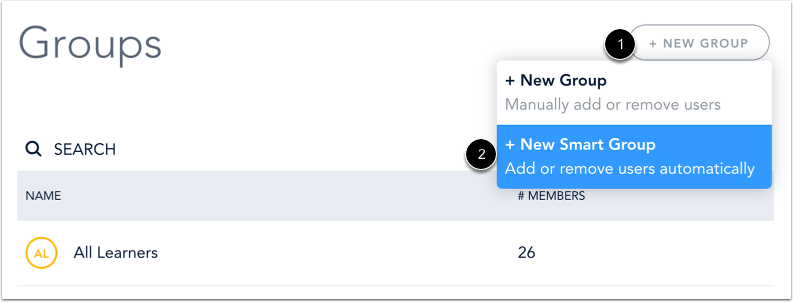
On the Groups page, click the Add New Group button [1]. Click the Add New Smart Group option [2].
Note: If you have not created a custom field for your users while doing a user upload, then you will not have the Smart Group option.
On the page that comes up, type in a title at the top.
Now it’s time to start creating rules. Rules will look at your users and add any who meet the criteria to the group. You can add as many or as few rules as you want.
First, select the operator [1]. You can choose to add learners who meet all of the rules, or add them if they meet any of the rules. If you are only creating one rule, then this first step doesn’t matter. It only comes in to play when you create multiple rules in one Smart Group.
Next, select an attribute by clicking in the text box and choosing from the dropdown [2].
In the second attribute field [3], choose the “limitation” for the value. You can choose to create a rule that checks for matches, “is”, or checks to make sure the field does not match, “is not.”
Next, we’ll search for the attribute value we want to match.
In the value field [1], enter the name of an attribute value or click the field and select from the options that appear below. Attribute values are part of a learner’s profile.
Select the full name when it appears [2].
Once you have selected the value, learners will automatically be added if they match the rules. You can continue adding more rules, or if you’re done, just click Save in the upper right.
Now that you’ve created a Smart Group, anyone who meets the criteria will get added, and any courses/programs assigned to the group will also be assigned to that learner automatically! It’s a great way to automate your learning and reduce your workload.
Before you assign a course, you must ensure that the course settings are correct. Our default settings work for most people, but it’s important to check these before assigning the course to make sure you don’t create more work for yourself down the road.
First, you’ll need to go to the Author section using the Application Switcher. This will show you the list of courses – you can search through for the course you want to assign, and click the title of the course.
Once you’ve clicked the name of the course, you’ll see the main course page with the settings at the top. To see all of the settings and change them, click More Settings. An illustrated guide to all of the settings is below:
- The Due Date is when the course will be due for your learners. You can change the number of days, or you can use the dropdown to change “within” to “on”, which will let you pick a specific date. Due dates do not impact a learner’s ability to take the course. They are just for reporting.
- If you set a course to Expire, then after a set period of time (that you determine), their certificate will expire. You can choose to Auto-Enroll the learner after the expiration date as well.
- Toggle this on to allow your learners to self re-enroll.
- The certificate is on by default. If for some reason you don’t want your learners to get a certificate, you can turn this off.
- The duration is an automatically calculated estimate of how long it takes to complete a course. You don’t need to change this unless you import something that doesn’t have the data available.
- You can give Continuing Education credits by turning this on. It will let you select how many credits the course is worth.
- You can decide how your SCORM content opens – the default is set to open in a new window.
- Required Score is set to 80% by default and should not be changed unless your course requires a different score.
- Turning on Limit Attempts will allow you to limit the amount of times a learner can fail a course. If they fail too many times, they will have to contact an Administrator to reset their progress.
- Handling Completed Unknown tells Bridge how to score a SCORM that shows as complete with no score.
- You decide how the quiz is scored – latest attempt or average attempt.
- This should be set at the root level so it’s best not to change this unless you have uploaded your own SCORM.
Please note: Some of these options may not be available to you depending on the type of course, or the level of access that you have.
Creating Courses in SafetyNow is a way for you to train your employees using content that you create, or even content you already have. There are three main types of courses:
SafetyNow Courses from Scratch
This is when you create a course from scratch, without starting from a PowerPoint. These courses are built directly in SafetyNow. You can add a custom title slide, as many content slides as you want, and as many quizzes as you want.
SafetyNow course are all mobile compatible and run without any plugins whatsoever. They can contain images, video, audio, and text. You can also distribute your quizzes throughout the course, or save them all for a final exam. You can set the passing percentage as well. These courses can also have Retain enabled, which will send single quiz questions at certain points after learners have completed a course, helping with knowledge retention.
Create a SafetyNow course when you want to build a course from scratch using text, images, audio and/or video courses.
SafetyNow Courses from PowerPoints
You have the option of uploading a PowerPoint into SafetyNow and starting your course with that. Keep in mind that this is fairly basic. The converter will take the PowerPoint file and convert it into images. Each image will be placed into an individual content slide, which you can then add audio, text, or video to.
In fact, other than starting from a PowerPoint, these are exactly the same as starting from scratch. You can add quizzes, new content slides, and enable Retain functionality.
SCORM courses
SCORM courses are built in outside tools, then uploaded into SafetyNow. Typically, these are created using programs like Articulate, Captivate, or iSpring, although there are many others. If you have a SCORM course ready, you can simply upload it and it should work just fine.
The downsides to this are that you cannot change the course from within SafetyNow – you have to use the original tool to make modifications. Additionally, Retain functionality does not work with SCORM courses. Finally, we cannot usually troubleshoot SCORM courses – since they are created by outside tools or other vendors, it is very difficult and sometimes impossible for us to fix issues. However, if you do have issues, we’ll do our best to get these resolved.
Creating a course from scratch is the most common way people create courses, so let’s start there. First, head to the Author section using the Application Switcher in the upper right. From there, click + New Course in the upper right. You’ll be brought to the below screen:
Let’s go over the basic options first, as labelled in the picture above:
- The Add Content button, which will add a single slide. Clicking on the arrow on the right of this will bring up the following two options:
- Add Question, which will let you write a quiz, and
- Add Cover Slide, which will let you create a custom cover slide
- Below that is the navigation pane. As you add content, each slide will show up here, and you can switch between them by clicking on them.
- Turns on Retain. See the linked article for more info.
- This will start a preview of the course, starting on the slide you’re looking at.
- This button Duplicates the course
- Click Publish Course when you’ve finished it completely.
- Click the X in the upper right to exit the course. All your changes will automatically be saved.
Next, we’ll talk about creating basic slides using the below picture as reference:
- Type in the title of each slide here
- This is where you’ll type the content of the slide, as well as add images, videos, etc.
- This will make the highlighted text either Bold or italics. If no text is highlighted, then this will affect the next thing you type instead.
- Insert a hyperlink. You can link to any site, it doesn’t have to be in SafetyNow
- Change highlighted text to Headers, with 1 being larger and 2 being slightly smaller. If no text is highlighted, then this will affect the next thing you type instead.
- Add a bulleted or numbered list
- Insert video, images, or audio. See this article for more details
- Enable or disable comments for this particular slide.
Feel free to make as many slides as you want.
Embedding/Attaching Files
Course slides don’t have to be just text. They can include images, audio, or even video! We’ll cover the two main ways of adding this type of content: hosted elsewhere, or hosted directly on SafetyNow. Both are accessed from the same menu.
First, click the button highlighted below:
This will open up the below window:
If your content is hosted on your own servers or elsewhere, then simply paste the URL into the first box. Otherwise, you can upload your files directly into SafetyNow by clicking the blue link, or dragging them directly into the window.
The following file types are supported:
- Audio: MP3
- Video: AVI, FLV, MP4, MPG, MPEG, MKV, MOV
- Video URLs: YouTube, Vimeo, Wistia
- Images: GIF, JPG, JPEG, PNG, PSD, SVG
Each file can be up to 10GB.
You can also add attachments, which will allow your learners to download any files you wish them to. Below are the supported file types for attachments:
- Documents: DOC, DOCX, PDF, PUB, TXT
- Other: AI, CSV, ICS, JSON, ODS, ODT, PPT, PPTX, RTF, VCF, XLS, XLSX, ZIP
Code Blocks
A new feature of the course editor is the ability to show blocks of code. This can be useful for technical courses where you need to show HTML or other code and ensure that it looks very consistent.
To insert a code block, click the highlighted button below:
This will insert a grey line where you can type or paste the code you need to show. The font is fixed width, meaning that each character will take up the same amount of space, ideal for code. Any HTML or Java placed in a code block will also not be interpreted by the browser and instead be displayed directly.
Hitting Enter will make a new code block, while hitting Shift+Enter will lengthen the existing code block, as seen below:
Once you’re done entering code, simply click the same button in the toolbar again to exit code block mode.
So, you’ve created some slides for your course, and you’re ready to start adding quizzes. Let’s discuss a few key points before getting started.
First of all, every quiz counts towards the learner’s final score whether it’s in the middle or at the end. You can change the passing percentage after you’ve finished the course, however, and it defaults to 80%.
Secondly, quizzes by default will halt a learner’s progress until answered and prevent them from going backwards. This can also be changed with the “Open Book” option in course settings.
Finally, by default learners will see the correct answer to a question if they answer it incorrectly. This can be changed in the settings as well.
Alright, let’s get into the process of making a quiz. First, click the arrow to the right of Add Content, and click Add Question:
This will bring up a menu giving you the option of 7 different question types. First, let’s talk about what a Smart Quiz is.
Smart Quizzes
Smart Quizzes are a bit different from writing a typical quiz question. Instead of writing the actual question, you’ll instead provide the system with a vocabulary word, a fact, or an ordered list. SafetyNow will the generate multiple questions based on the information provided. These questions will be different for each learner, as well as each attempt on the course. They vary from True/False questions, fill in the blank questions, multiple choice questions, and more.
If you want to see what kind of questions each smart quiz will generate, click the eye in the upper right to preview the question. You can generate questions multiple times to get a feel for what the variety of questions are.
Let’s go through the types of Smart Quizzes one by one.
When you make a vocabulary quiz, you will write the definition of 2 or more words you want the learner to know. 3-4 is the ideal number so that the quiz pool is large, but not too bulky for you to write. Once you’ve provided this info, the system will generate a pool of questions challenging learners to match words with their correct definitions, fill in the blanks, or answer true/false questions.
Steps in a Process quizzes will ask you to lay out the order of a process. 3-5 steps is usually sufficient, but it can be as large as you want. The questions generated will have learners filling in blanks in the process, answering multiple choice questions about what step goes where, and more.
Factoids are a fun way of generating lots of questions with little information. First, you type in a fact that you want a learner to know. From there, you will type in “distractor words” to replace the various words in the fact you just typed. These words will then be used to create a pool of questions challenging learners to spot untrue facts, fill in the blanks, and more. Here’s an example:
As you can see above, we’ve generated distractor words for multiple words/phrases in the fact, which will generate a large pool of questions! Here’s an example question:
Traditional Quiz Questions
These questions are much more straight-forward. You will write a question, and the system will ask the learner just as you typed it. You do have the option of randomizing the order of answers, however. The traditional quiz types are Multiple Choice, Multiple Answer, Sorting, and Short Answer.
Multiple Choice and Multiple Answer are very similar – learners read a question, then choose either a single correct answer, or multiple correct answers. The order of answers can be randomized, although I suggest turning that off for True or False questions.
Sorting questions allow you to write out a process in its correct order. Those will subsequently be shuffled, and the learner will have to put them in the correct order.
Short Answer questions are slightly different in that they are not graded. The learner is presented with a question, and then types in their response. Those responses will be recorded in the Course Summary for you to see later.
To assign a course to an individual, first find the course in the Author section of SafetyNow. You can search for the course, or browse through the entire list.
Once you’ve found the course, click on the title of the course to be brought to this screen:
Click on Learners and you will be presented with a list of everyone already enrolled in the course. To enroll a new person, click on + Learner in the upper right, and type their name into the box that appears. Once you find the person you are looking for, click on their name in the dropdown.
If you have notifications on, that person will receive an email notifying them of the assignment. In any case, they can now log in to take their course.
Courses can be assigned individually, or they can be assigned to groups of people. Assigning courses to a group can be incredibly useful in building a curriculum. When you assign a course to a group, that assignment will “stick” and anyone added to the group will automatically get the course. This can be used to create a curriculum for different groups without having to assign the courses to each individual.
Before assigning courses to a group, you’ll have to create at least one group first.
There are two ways to assign courses to a group: by individual course, or through the groups menu.
Assigning individual courses
The first way is to pick a course, and then assign it to a group. Start by going to the Author tab from the Application Switcher and searching for the course you need. From there, click on the Groups tab, as pictured below:
Once on the Groups tab, click on the +Group button in the upper right.
This will open up a window allowing you to search for an existing group. Type in the beginning of the group name and it will automatically pop up below. Click on that group to add it. You’ll then decide a relevance by clicking on the dropdown on the right side. If you want them to take it, then change this to Required. Finally, click Save.
You can see these steps in order below:
And that’s it! Any time someone is added to the group, they will get the course you just assigned to that group.
Assigning through the Groups section
Instead of assigning individual courses to multiple groups, you can instead go to an individual group and assign courses that way.
To start, go to the Admin section under the Application Switcher. From there, click on Users & Permissions, and in the sub-menu that appears, click on Manage Groups.
In the list of groups that appears, click on the name of the group you want to assign courses to. From there, you’ll be brought to a page showing all the members of the group. To start assigning courses, click Relevant Content at the top. To assign a course, click +Content in the upper right.
In the new window that opens up, you can start adding courses, or any other type of content. Just type the beginning of the name to search, then click on the appropriate course. That will add the course to that group, just like if you’d gone to the course and added the group that way.
This view also allows you to see what’s already been assigned to the group in case you need to change it.
After assigning a course, you may need to change the due date, remove a learner from a course, or even pass a user for a certain course. Click any of the below links to jump straight to the section for the change you need to make:
- Change the Due Date
- Pass or Reset a learner
- Set the completion Score
- Change the expiration date
- Remove a learner
Getting Started
To make any changes, you’ll need to find the course. First, go to the Author tab and search for the course you wish to preview. Once you find it, click the name of the course to be brought to the main course page. From there, click Learners.
You’ll see your list of learners, and from there you can start making changes.
Change the Due Date
To change the due date, simply click on the number of days due in the Due Date column, as pictured below:
Once you’ve clicked it, you’ll get two options: No due date and Pick a date.
Clicking No due date will change it so the user won’t have any particular date that they need to take it by. They will not show up as overdue on reports, or get emails about being overdue.
Clicking Pick a date will let you pick a specific date on a calendar. The new due date will show up once you have chosen a particular date.
This will only apply to the single user you clicked, so if you need to make more changes, you’ll need to do it for each learner individually.
Pass or Reset a learner
If a learner has not completed a course, you can manually pass them. This will set their status to Complete and use today’s date as the passing date. To do so, click the circle in the progress column for a user who has not passed the course yet, as pictured below:
Once you click the circle, just click the option to “Mark Complete.”
You can also reset a learner back to the beginning of a course, if they are in progress or have completed it. To do so, click the partially filled circle or check mark for a user (pictured below), and then click Reset Progress.
If a learner was in progress, then they will have to take the course from the beginning. If they had completed it, it will remove their certificate and they’ll have to complete it again.
Set the Completion Score
In the screenshot above, you can see that the SafetyNow account passed the course with 100% on the quizzes. You can change this simply by clicking the score and typing in a new number. It’s as simple as that!
Change the Expiration Date
Not all courses expire, so this may not apply to you. If your course is set to expire, you can change the date to whatever you want it to be. To do so, just click the expiration date in the Expires column, pictured below:
This will bring up a calendar where you can choose a new expiration date.
Remove a Learner
If a learner is required to take a course, i.e. they did not sign up for it themselves, and they have not completed it yet, you can remove their enrollment. This is as simple as clicking the X in the final column, as pictured below:
Adding users one at a time
The first step to getting your account up and running is to add users. If you don’t have too many users to add, then the easiest way to do this is to just add them one at a time.
First, navigate to the Admin section using the Application Switcher.
From there, click on Users & Permissions and in the menu that appears, click Manage Users.
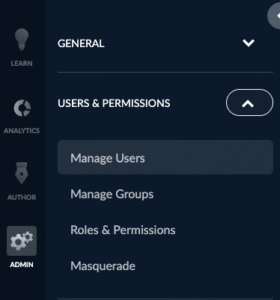
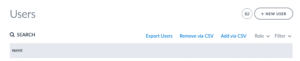
To add a new user, click on +New User on the right side. A text box will appear – type in their Name and click Create.
The final step is to fill in their details. Click on the user you just created to open up their profile. From there, click Edit User at the top. This will bring you to the below screen, where you can click on any field to edit it:
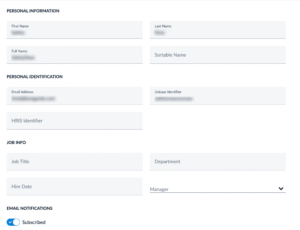
You want to fill out at least First name, Last name, and Full name, as the full name shows up on the certificate. You can also fill out any other fields you want to.
As soon as you click Create, the user will receive an email notifying them of their new account and asking them to create a password (unless you turned those notifications off).
If your user does not have an email address, no problem – just leave that field blank!
Once you’re done, click Save.
Uploading multiple users via CSV
- Gather the user info you want to upload in a spreadsheet
- Save it as a CSV
- Upload the sheet
- Match columns in SafetyNow to your spreadsheet
- Save the upload
We’ll go over these one at a time.
Creating Your Spreadsheet
Creating a user upload is very simple. There aren’t any complicated formats you need to know, or specific naming structures. At the bare minimum, all you need is a unique user ID and a name. However, you can also add as many custom columns as you want and make custom fields to fit that information. Here’s an example spreadsheet you can use to build off of. I’ve also pictured it below:
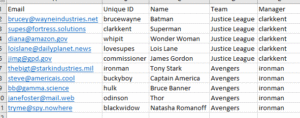
As you can see above, we’ve included email addresses for everyone, given everyone a “Unique ID,” or username, and included the custom field for “Team.” Please disregard the “Manager” column, as this is not applicable to CSV uploads.
You can also choose to leave out the unique ID and just use Email addresses as long as everyone has an email address.
Save this file you’ve created as a “CSV” file. That will allow you to upload it into SafetyNow.
To get started, we’ll need to get to the Manage Users screen.
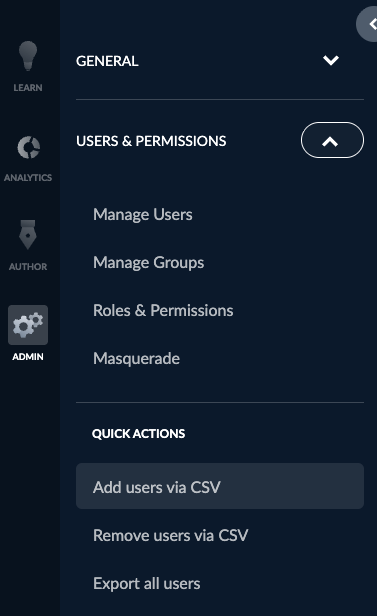
First, navigate to the Admin section using the Application Switcher. From there, click on Users & Permissions and in the menu that appears, click Manage Users.
From here, click Add via CSV either through the admin panel or as pictured below:

This will bring you to a new screen. Click “choose a file” or just drag your CSV onto the window. That will upload the CSV and allow you to start matching columns to fields.
The first step is to drag the Login ID Key [1] to the field with your Usernames [2], or to the email field if everyone has an email. Just click and drag it to the top of the appropriate column.
Next, you’ll be asked to drag the Manager ID Key to the appropriate column. Please skip this step, by clicking the blue “Next” button in the upper right corner, or by clicking on the “3 Add Other Data Fields” button, as shown below.
Now it’s time to match the rest of the columns to the appropriate fields. For existing fields, simply drag the names over to the appropriate columns. It should end up looking something like this:
However, we don’t have anything for Team. That’s okay, we can just create a New Field! First, click New Field, then type in the appropriate name, and finally drag it over to the correct column, as seen below:
When you’re done, click on Finish in the upper right. That will bring you to a summary screen, which will show you how many users will be uploaded or modified, and any possible errors. You shouldn’t have any errors, however, so if you do, please contact us.
To finalize the upload, click Confirm.
And that’s it! Your users will be created, or modified if they already existed. If email notifications are turned on, each of them will also receive an email letting them know they have a new account.
