Industrial Ventilation – Units and Measures – Fact Sheets

HOW IS THE DILUTION VENTILATION RATE MEASURED?
Air changes per hour (ACH) are generally used as a way to measure the dilution ventilation rate.
An air change means the replacement of the entire volume of air in the workspace. The air change rate indicates how many times per hour a room (workplace) needs to have the air totally replaced.
The required air change rate is sometimes given in ventilation regulations and ventilation design standards. For example, a flammable storage room requires six air changes per hour according to US OSHA requirements. The Canadian Standard CSA Z 317.2 “Special Requirements for Heating, Ventilation, and Air Conditioning (HVAC) Systems in Health Care Facilities” sets the minimum total air changes at 20 changes per hour for operating rooms.
The following formula can be used to determine the air exchange rate:
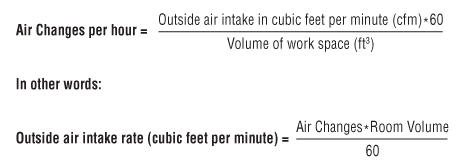
Here is an example:
The volume of air in a room which is 12.5 meters (41 feet) long, 12.5 meters (41 feet) wide, and 4 meters (13 feet) height is:
Vroom = 12.5 * 12.5 * 4 = 625 m3 (41 * 41 *13 = 22072 ft3)
To change this volume of air only once per hour, we need an air rate of:
Air flow rate (m3/h) = Air exchanges * Room Volume = 625
Or

If this room would be an operating room, then the recommended ventilation rate would be:

The air changes per hour (or minute) may not be an appropriate measure for ventilation criteria when controlling certain hazards, heat and/or odours. The ventilation rates should be determined based on several factors such as the amount of contaminant generated, the toxicity of that contaminant, the nature of the emission (steady or cyclic), and the mixing effectiveness (not just the size of the room).
Source: © Copyright 1997-2021 CCOHS